


When it comes to the question of where to stash our savings, us Kiwi love a bank.
As of June 2026, New Zealand households have roughly $275 billion squirreled away in bank savings products—including savings accounts (on-call, bonus, and notice saver) and term deposits.
While “just whack it in a term deposit” is still often the default, these days there are a whole lot of other options out there worth considering.
One of those other options is peer-to-peer (or P2P) investing—an industry that, despite steadily gaining traction in New Zealand for over a decade, remains relatively unknown.
So, let’s fix that.
What is P2P investing, in plain English?
P2P is exactly what it sounds like: Kiwi investors lending money directly to creditworthy Kiwi borrowers, without the bank in the middle.
Instead, loans are facilitated by specialised P2P platforms—which work a bit like money match-makers. The sorts of loans you can invest in vary from platform to platform, including everything from personal and business loans through to residential mortgages and construction finance.
P2P’s a pretty big deal overseas—platforms like Mintos in Europe and Happen Bank in the US have each lent billions—but in New Zealand it remains a comparatively small (yet still tightly-regulated) corner of the investing world. Every provider, Squirrel included, needs a licence from the Financial Markets Authority in order to operate.
So how does P2P investing compare to a bank term deposit?
To make it clear right off the bat: P2P investing is different to a term deposit, and it's important you understand the difference before deciding what's right for you.
With that said, here’s how they stack up on a few key points:
How your money is invested
With a bank term deposit, your money goes into the bank’s big pool of funds and they decide how to lend it out from there. As the depositor, you have no visibility over where it goes (or the returns it’s generating).
With P2P investments, you can choose how you want to put your money to work—whether it’s backing a business to grow, or helping Kiwi into homes—depending on the P2P platform. Each platform usually offers a number of different loan types to invest in as well, with different risk and return profiles.
At Squirrel, for example, we have two term investment classes to choose from—Home Loans and Construction Loans.
Getting your money back
If you want to access funds in a bank term deposit before your term is up, you’ll usually have to sacrifice some of your interest returns, and give the bank a month’s notice.
Several P2P providers in New Zealand, like Squirrel, now offer a secondary market, giving investors the ability to list their investments for sale, should they wish to get their money out before term. Some charge a fee for this service; Squirrel doesn’t—no fees, charges or penalties.
As of July 2026, the average time to sell via our secondary market is 26 hours for Squirrel Construction Loan Term Investments, and 3.6 days for Squirrel Home Loan Term Investments. You can view time to sell and other performance metrics here.
However, there is no guarantee that a buyer will be available when you want to sell your investment, so you should be prepared to hold it until the end of its term if needed.
Risk and protection
Bank term deposits are generally considered one of the lowest risk investment options out there.
With P2P lending, investors take on the risk that a borrower may not repay their loan (known as credit risk), rather than a bank taking on that risk. As a result, P2P investments generally carry a higher level of risk than bank term deposits.
At Squirrel, we manage investor credit risk three ways:
- Credit assessment—each and every Squirrel borrower goes through the same rigorous credit assessment (including credit checks, ID verification, and a full affordability test) before a loan can be drawn down.
- Squirrel’s Reserve Funds—a small portion of every borrower's interest payment is set aside as a safety net, which builds up over time. If a borrower misses a payment or defaults on a loan, the Reserve Fund is designed to help cover missed payments to investors. Squirrel’s Reserve Funds aren’t guaranteed, you can read more about how they work on our website.
- Security—for Squirrel Home Loan and Construction Loan Term Investments, in most cases the loans are secured by a first mortgage (or right to place a first mortgage) over residential property. This means if a borrower defaults, Squirrel can sell the property by mortgagee sale. Often the full value of the loan is recovered this way, and if it is not, that’s where the reserve funds step in to support investors.
Returns
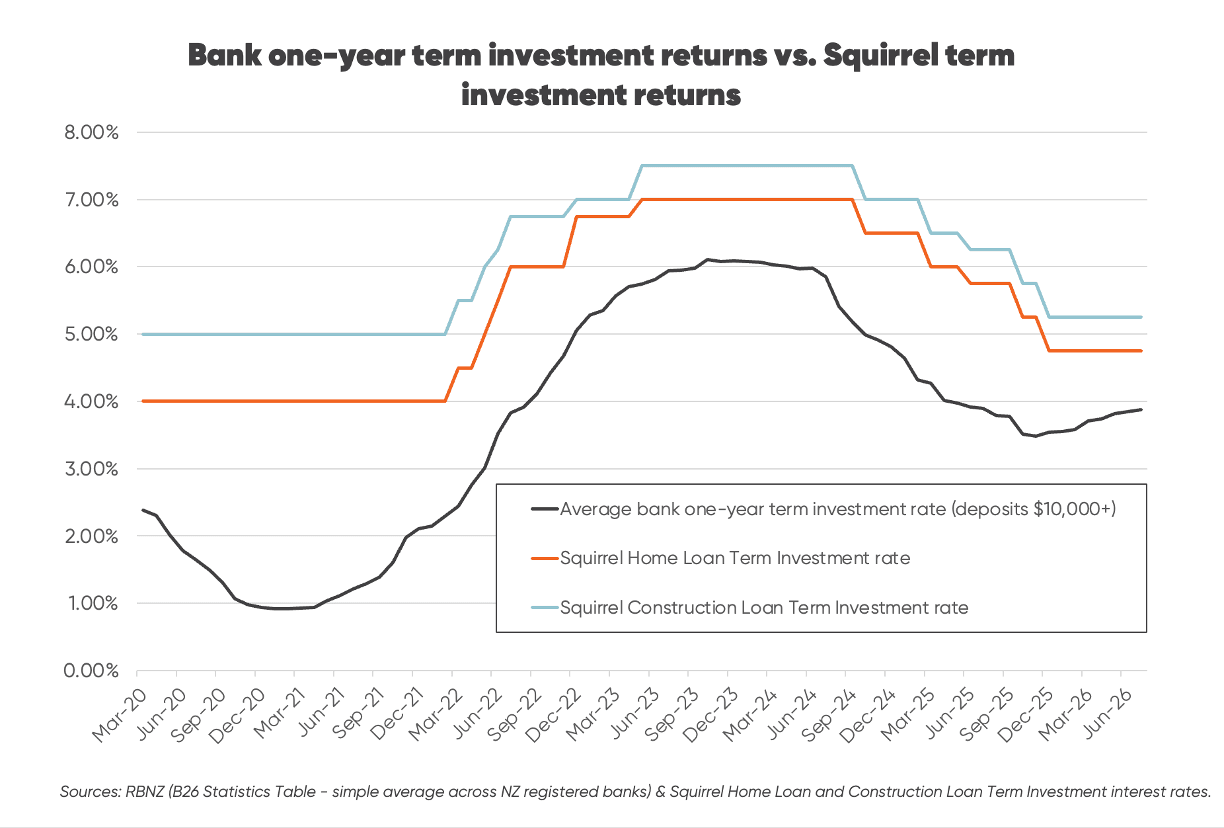
There are a bunch of factors that go into how a bank sets its term deposit rates—including broader funding costs and competing banks' rates. While borrower and depositor rates tend to move in the same general direction, there's no direct link between the two.
With P2P lending, there is a more direct relationship between what borrowers pay and what investors earn, with the P2P provider charging a fee for facilitating and managing the investment. This means more of the interest paid by borrowers can be passed on to investors. In return, investors take on the credit risk associated with the loan, rather than a bank bearing that risk.
Getting started
The minimum investment for a bank term deposit varies from $1,000 to $10,000 across the big five lenders, depending on the term. Note that smaller investments might mean a lower interest rate.
Barriers to entry tend to be slightly lower with P2P platforms, although it still varies depending on the platform. With Squirrel, you can get started with just $100, making it a low-stakes way to test the waters before committing further funds.
Right, so what exactly are you investing in with Squirrel?
Every dollar invested with Squirrel goes towards helping Kiwi into homes, with our Term Investment classes investing in loans relating to New Zealand residential property.
We have two term investment classes available via our platform.
With our Home Loan Term Investment class, your money is lent out to credit-worthy homeowners and property investors. Terms run up to seven years.
Our Construction Loan Term Investment class helps fund small-scale residential developments—working with experienced property professionals borrowing for business purposes. These loans run for shorter terms of up to two years, and carry a slightly higher risk rating and returns, since developers have more exposure to movements in the housing market.
Both term investment classes have Reserve Fund protection, and have access to the Squirrel secondary market. Interest is paid straight into your Squirrel account, and you can manage the whole thing — investing, selling, withdrawing — 24/7 via the Squirrel app.
Why it matters beyond your own bank balance
Squirrel is 100% New Zealand owned and operated—which means your money (and the good it’s doing) stays on Kiwi shores.
And if P2P isn’t quite your thing
Squirrel has a few other ways to put your money to work—including our high-interest On-Call Account, and Squirrel Monthly Income Fund (a more hands-off option for investors), and options for wholesale investors.
Whichever option you land on, the golden rule stands: understand what you're investing in, know it's genuinely different from a bank term deposit, and only invest what you're comfortable tying up for the term.
Bank term deposits aren't going anywhere—but now, at least, you know what else is on the menu.
Learn more about Squirrel’s Term Investments and how they could help grow your money here.

DISCLAIMER: This is paid content prepared on behalf of Squirrel Money Limited. It is general information only, does not constitute financial advice, and does not take into account your personal financial situation, objectives, or needs. The returns discussed in this article are historical figures only, are not guaranteed, and can go up or down — past performance is not a reliable indicator of future performance. To view Squirrel’s disclosure statements and other legal information, please visit our Legal Agreements page here. FundRock NZ Limited is the manager and issuer of the Squirrel Monthly Income Fund. The product disclosure statement can be found here.